|
Gear Ratios for:
Pick the best combination of gear ratios to match your engine's power specs to how and where you wish to drive your Land Rover.
The gearbox used in series Land Rovers was first used by Rover in 1932 Though it has seen several modifications it is an old design that was intended for low powered engines. The Series gearbox is generally considered to be strong enough for about 120 HP, 160lbft is about the limit on torque. If you install an engine with more HP or torque consider updating the gearbox. The LT77 is not much stronger than the Series gearbox. It will work fine for a Land Rover 2.5dt and the newer tdi but is a little weak for the V8s. The later Land Rover 5 speed gearboxes would be a good match for the newer Land Rover 4 cylinder engines and the 3.5L aluminium V8. The last of the 5 speeds, the R380 should be able to handle up through the Aluminium 4.6L engine in stock form. If you are installing a higher power engine, especially a high torque diesel, you are better off looking at options other than pre 2007 Land Rover gearboxes. When making drive train upgrades it is generally a good idea to pick components that fit without special adapters whenever possible - less engineering involved; you get components proven to work together and have fewer replacement problems should something break. Different engines have different needs. Smaller petrol or turbo diesel engines often rely upon higher RPM's for power. Larger engines usually put out a lot of low end power and get their best fuel economy at lower RPM's Your choices in drive train components define how your Land Rover will handle, so the more homework you do before locking yourself into specific drive train components the better your chances of ending up with a vehicle that meets your needs and is a pleasure to drive. The first thing you need to do is honestly define what the vehicle will actually be used for. A vehicle used mostly on the freeway with off road travel on maintained trails will have very different gearing requirements than a serious rock crawler or mug bogger that gets towed on the highway. You need to pick gearing that will match your engine to the types of driving you do The first thing you need to do is learn your engine's sweet spot. This is the RPM range where your engine gets best fuel economy and is up on both the horsepower and torque curves. This is the RPM range you want to be in for both highway and off road travel. Your challenge is to find a gearbox, transfercase and differential combination that will allow your engine to run in that sweet spot both on the highway and driving through any off road obstacles that you are likely to encounter. If you tend to convoy with other Land Rovers it would be helpful if you have overall gear ratios that are similar to the vehicles you travel with. I found the stock Series Land Rover low range first gear ratio (40.7:1) to be too tall for many off road situations. Having 10 years experience with a 70:1 ratio I have found it to be too low for anything but the most technical rock crawling situations (with 33.3 inch dia tyre). At this time I'm leaning towards somewhere around 55:1 to 50:1 as being the best overall low range ratio for use in many different situations with 32 - 34 inch dia tyres. This target ratio is for an engine that has plenty of power off idle and a lot of torque in the 2000 RPM range. Smaller engines or diesels that need to wind up the turbo will often be better off with lower gearing to get those RPM's up. If are thinking about a box with a granny first for technical rock crawling, remember that it comes at a price. There is usually a huge gap between that super low rock crawling first gear and second gear low range. A gap where an in between ratio would be really handy for moderate trails. Overall gear ratio at the axle = gear selected in gearbox X selected transfercase ratio X ring and pinion ratio Stock Series gear ratios were chosen on the assumption that the truck would mostly be used at or below 60 MPH. For modern freeway driving you will want a five speed gearbox with the fifth being an overdrive gear or a high ratio transfercase or an overdrive or taller ring and pinion gears. Here are some thoughts about these different parts. Select your transfercase high range and differential ratios for highway cruise RPMs
Differential and axles The Series II and IIA One Ton models came with ENV axles front and rear. These are the strongest stock axles and differentials available and would be a good swap for high torque conversions. The Series III One Ton Land Rovers came with Salisbury axle assemblies front and rear. The front Salisbury makes for an easy bolt on upgrade for a Series truck. The Series ring and pinion gears are thinner and weaker than the 3.54:1 gears. GBR Utah (formally Great Basin Rovers) produces a range of ring and pinion gears that are much stronger than stock. These offerings are a good choice to go with significant power upgrades. GBR supplies 5.13, 4.75. 4.1, 4.43, 4.14, 4.11, 3.9 and 3.54 ratios for the Rover diff and 4.7, 4.11 and 3.54 Salisbury ratios. GBR is your best place to get uprated ring and pinion gears and they can supply assembled differentials ready to slip into your axle housing. ENV and Salisbury ring and pinion gears are normally strong enough to handle whatever you put in front of them. Figuring out a differential ratio: If you have an unknown differential sitting in front of you, you can calculate the ring and pinion gear ratio by counting the number of teeth on both the ring gear and the pinion gear. Divide the number of teeth on the ring gear by the number of teeth on the pinion gear and you get the differential ratio. ROAMOff road is a good source for uprated Rover 24 spline axles. Add an aftermarket 24 spline Rover diff and Salisbury drive flanges and you get a very robust Rover rear axle assembly. This is your best bet for an 88 upgrade because the 88's rear prop shaft is short. A Salisbury differential is longer requiring a shortened prop shaft. . Transfercase Both the Series transfercase with a 4.7:1 differential and the LT230 with a 3.54 differential have similar overall ratios at the axle. The LT230 was designed to do most of its gear reduction in the transfercase so that the prop shaft. turns slower. You should consider coupling the transfercase with a stock or near stock ring & pinion ratio for that transfercase. Ashcroft makes a kit that converts the LT230 to part time 4WD for use in Series trucks.
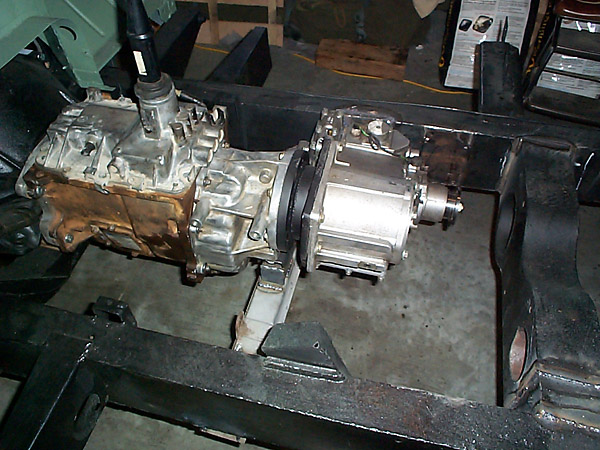
Gearboxes Granny first gearboxes were never intended for use in a drive train that includes a transfercase. The Granny first ratio is intend to be the equivalent of a low range first gear. The granny first and a transfercase serve the same function. Except fort purpose built extreme rock crawling you are almost always better off picking a gearbox with a close ratio gear set. Low range first gear is way too low for most off road driving and there is large ratio gap between first and second which often leaves low range second too high for a lot of off road conditions. For most technical off road driving a low range first ratio in the range of 55:1 to 50:1 at the axle is close to ideal. The Stock Series low first ratio is 40.7:1. Granny first gears will give you a low range first somewhere in the 80:1 to 70:1 ratio area. It is very hard to keep engine RPMs steady with those ratios. Four speed gearboxes are close in length to a Series gearbox so you can usually fit the engine and gearbox in the truck without moving the transfercase rearward from the stock location. A five speed gearbox is longer and you will need to move the transfercase rearwards. This will require moving the transfercase cross member and custom prop shafts. Moving the transfercase towards the rear will place the front prop shaft closer to the bulkhead cross member. A half moon shaped divot in the leading edge of the bulkhead cross member should be added for additional clearance. Model 88's have a very short rear prop shaft. When choosing components try not to reduce the spacing between the rear prop shaft mounting surfaces. This is just asking for expensive high tech rear prop shafts and decreased reliability. The best solution for a longer gearbox in an 88 may be to move the engine forward. Land Rover did this when they started using 5 speed gearboxes. The rear axle on a Series Land Rover sits 1-1/2 inches forward of the body rear wheel arch. You can move the rear axle assembly rearwards 1-1/2 inches using off set plates between the axle mounting pads and the springs and pick up 1-1/2 inch additional spacing for the drive train without negatively affecting the rear prop shaft geometry or body clearance.
Stock Land Rover gearbox and transfer case ratio charts
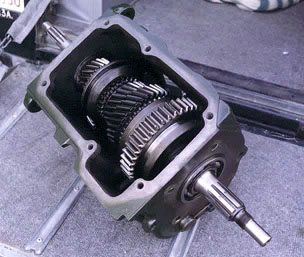
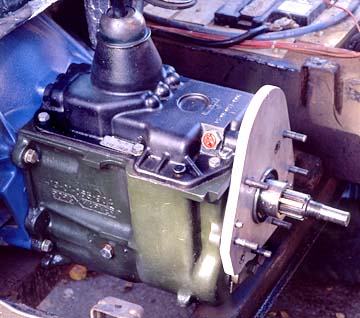
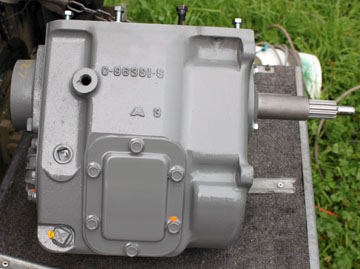
Borg Warner T-18 :The Borg Warner T-18 transmission is a top loading four speed with granny first gear that was used in 1965-1985 Ford pickups, some Jeeps and IH Scouts. Ford used three different versions of this transmission. From 1966 until 1978, many T18s used a T98 shifter assembly. 1979-newer T18s used a three-fork shift cover assembly that shifts reverse gear directly. Earlier versions of the T-18 go into reverse by shifting to the right then up. Later versions shift to the right and down the same as a series gearbox. Parts are easiest to find and cheapest for the Ford versions of the T18. Off the shelf clutch & bell housings adapt the Ford T-18 to a small block Ford engine There are 12 versions of the Jeep T-18 transmission, most of which are close ratio gearboxes. Several parts for the close ratio Jeep T-18s are no longer available. The Jeep T18 is usually a direct bolt up to the Dana 18 transfer case There are adapters available to fit Chevy engines to the Jeep T18. International harvester only used the close ratio version of the T-18. Engine & transfer case adaptors can be hard to come by. The T18 gearbox has a cast iron housing and top plate . The PTO side plate is on the right side. The housing casting is 13-01. Your best bet for an adapter to go between the T-18 and a Series transfercase is with Advance Adapters. Contact Mathew Jackson for details. Otherwise you will need to fabricate an adapter plate and a hybrid output shaft.
housing length is 11.875".
Oil Note: Use a GL-4 rated oil instead of GL-5. GL-5 has a higher sulphur content that is mildly corrosive to the bronze alloy syncros used in this gearbox. StaLube and RedLine are brands to look for.
Borg Warner T-19 :The Borg Warner T-19 transmission is a top loading four speed with granny first gear that succeeded the T-18. The T-19, was used in '74-'88 Ford pickups and some IH trucks and Scouts. The T-19 appears identical to the T-18 except that the PTO side plate is on the left side and the housing casting is 13-09. Most T-19 transmissions used in Ford trucks used the close ratio gear set. The close ratio T-19 can give you a very usable low range first gear ratio when used with a Series transfercase. Again your best bet for an off the shelf adapter is from Advance Adapter. The IH Scout T19 was available from 1975 to 1980 with both close and wide ratio options. As for the IH T18, they had a unique case and input shaft that makes adapters hard to find. housing length is 11.875".
Oil Note: Use a GL-4 rated oil instead of GL-5. GL-5 has a higher sulphur content that is mildly corrosive to the bronze alloy syncros used in this gearbox. StaLube and RedLine are brands to look for.
New Process NP-435:This is a four speed with an unsynchronized granny first gear. This strong and reliable transmission usually fitted to 3/4 ton pickups up to 2-1/2 ton trucks. They were used on Ford trucks (1964-1987), as well as Dodge trucks (1963-1990) Jeeps, IH pickups and Scouts (1964-1987). A small number of NP-435 gearboxes were built for GM trucks (1964-1972) Almost all of them has the close ratio gear set. A very few were made with the granny gear set. By far and away, the Ford versions are the most common and most adapters are made to fit the Ford version. Early versions of the NP-435 use a ball bearing on the input shaft. Later versions use a taper bearing on the input shaft. Gear sets from the later roller bearing set can be fit into different NP-435 housings. This means the common Ford granny gear set. can fit into a Chevy housing and a Chevy close ratio gear set. can fit into a Ford housing giving you the choice of the ratios that best fit your driving. A Ford clutch disc must be used with the Ford gear set. and a Chevy clutch disc must be used with the Chevy gear set. and you use the pressure plate that goes with the engine. Either a Ford and Chevy top cover can be used with either late case. The Ford cover is shorter but the gear throw is longer. The Chevy housing is taller with a shorter shift lever throw. You will likely have to shorten and rebend the stock shift leaver to fit.
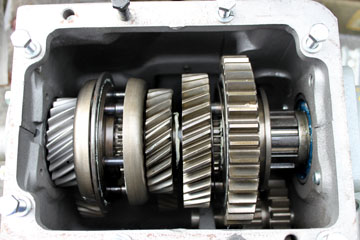
The 2WD versions have a square tail-housing bolt pattern, while the 4WD version has a trapezoid pattern (lower bolts farther apart than top bolts). 4WD trucks that had a divorced transfer case also used the square tail housing bolt pattern. Different transfer case adaptors fit different tail bolt patterns. Be sure to verify that the gearbox will fit the adaptor for the transfer case you plan to use before handing over your money. There are 3 or 4 different adapters available to connect the NP-435 to the Series Transfer case. Advance Adapters has one type. Timm Cooper had at least two versions of adapter (only available used) and Ike has at least 2 versions of an adapter plate and custom tail shaft. The NP-435 has an aluminium top cover which is usually stamped with 'NP' enclosed in a circle. The Chevy top cover is a little taller than the Ford top cover with puts the shift ball a little higher. This means the shift throw is a little shorter in the Chevy version than the Ford version. First gear has a longer throw then the other gears because it is non-syncro. The Chevy NP-435 top cover fits & works on top of a Ford NP-435 case and is a way to get a slightly shorter shift pattern. The GM versions are hard to find as GM mostly used their own SM-465 gearboxes. The common version is the late version with the 4.56:1 first gear. Wide ratio versions (6.68:1 first) exist but are extremely hard to find. Ford versions are almost all the wide ratio version. Most people by a box for the engine they have to get the right case and a box for the gear set they want and combine the two. I did this to get a close ratio gear set. in a Ford case to fit my Ford bell housing I ended up with a Ford NP-435 case, Chevy NP-435 top cover and close ratio gear set. Housing length is 10.875"
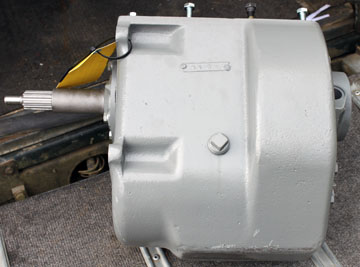
SM420The SM420 was used in ½, 3/4, 1 and 2 ton GM trucks from 1947 to 1967. Later versions had two horizontal ribs cast into the passenger side of the case. The "SM" in the transmission's designation stands for Syncrho-Mesh. The SM420 has a "H" shift pattern, with reverse being towards the left side and down. The a power-take-off (PTO) port is on the driver's side of the case Housing length is 10.4"
SM-465The SM465 was used in GM trucks from 1968 to 1991. They are found primarily in GM and Chevrolet trucks, Blazers, Suburbans and many other models falling under the 1/4-ton to 1-1/2-ton platforms. These have a reputation of being very robust. There are three versions of the SM465 each with about the same strength 1968 - 1978: There were both 2wd and 4wd versions. The 4wd version has a 10-spline output shaft and 4wd adapter housing. The 2wd version has a 35-spline output shaft compatible with a drive shaft yoke and 2wd style tail housing. Internally, they are identical to each with the exception of the output shaft and rear housing. Note: Unlike axles, the # of splines here has nothing to do with strength. 1979 - 1991: The short 10-spline, 4wd output shaft was replaced by a 32-spline 4wd output shaft and a different output housing to connect to the New Process 205 transfer case 1988-1991: The last years of SM465 had a 4th gear switch to signal cruise mode operation to the GM EFI Engine Control Module. This version had an aluminium top cover. housing length is 12.0"
NV4500The NV 4500 is a fully synchronized top loading five-speed transmission with a cast iron case, aluminium top cover and dual PTO ports. It is found in GM and Dodge trucks. The 1993, 1994 GM version has a different bell housing pattern, a lower first gear ( 6.34:1) and an unsynchronized reverse gear than later units. 1995 and later NV4500's have a higher 5.61 low ratio and reverse gear synchronization. The NV4500 has a case length of 12.37" plus an extension housing length of 6.5" making the overall length to be 18.9 inches. This housing contains fifth gear. 2wd style housings are longer. GM input shafts are 6-5/8" long . Dodge input shafts are 7-5/8" long.
Housing length 18.9"
Adaptor company web sites
|
|||||||||||||||||||||||||||||||||||||||||||||||||||||||||||||||||||||||||||||||||||||||||||||||||||||||||||||||||||
|
If you would like to discuss any of the contents, or just say hi, please feel free to .
© 1997, 2001, 2017 TeriAnn Wakeman. All rights reserved. |