|

Converting a Series Land Rover to front wheel disc brakes
An overview
Land Rover 109 drum brakes are adequate for stopping in the forward
direction. With two leading shoes they provide a lot more
forward braking power than conventional drum brake arrangements
with a leading and a trailing shoe. However this extra stopping
ability in the forward direction comes at the cost of stopping
ability in the rearwards direction. This can become a real
safety problem when a 109 Land Rover comes to a halt nose up on
a steep slope. It is very difficult to hold a 109 Land Rover
stationary in such a situation or to halt the Land Rover's movement
backing down a steep slope.
Drum brakes do not function well right after a water crossing
when the shoes are wet. My reasons for switching from front
drum brakes to front disc brakes are to achieve good braking in
both directions and to have good braking right after water
crossings. Note that vehicle manufacturers use more powerful
power brake boosters for disc brakes than Land Rover used for
the Series. You
should not expect increased braking with the same pedal pressure
when converting from drum to disk using the same master cylinder
and vacuum booster. If you are just looking for increased
braking for the same pedal pressure look first at more powerful
brake power boosters.
Series Land Rover front disc brake conversion kits
There are 5 disc brake conversion kits for Series Land Rovers
that I am aware of.
In alphabetical order:
Bearmarch kit:
These
are out of production but you may occasionally find someone
selling an old set on ebay or a boot sale. The Bearmarch
disc brake kit was an imitation of the early Santana Girling
system and was made in Iran. The quality of the imitation
Girling Santana brakes is reported to be low.
Heystee Automotive Components conversion
kit - Formally T.I.
Console.
Pre-2010 disc brake conversion kits are based upon the disc brakes that come on the
Spanish built Santana PS10 (Iveco Massif). The
PS10 is basically a Land Rover clone so is in the same weight
range as a Series LR. The brake calipers are made by Girling. The
front disc brakes are a 2 piston vented system. The
rear system has the same wheel hubs but slightly thinner discs
(non ventilated) and smaller calipers. This is also a straight
fit without modifications just like the front ventilated system.
A
custom back plate is bolted onto the swivel housing in place
of the drum brake back plate and the PS10
Girling brakes bolt to the plate. There
are no grinding or modifications of existing components
required. Wheel spacers are required to fit the Series wheel
though
As the Santana (Massif) is not available in North America,
North American's would need to source replacement parts directly
from Heystee
Automotive Components or an IVECO dealer. Santana
has been taken over by IVECO and the Santana
PS10 has been renamed the " IVECO Massif". Americans
can usually have pads & rotors shipped by air to them from
Europe in less than a week. Alternatively, if quick repairs
are important, one can keep a backup set of pads and rotors on
the shelf. IVECO has ceased production of the disc brake components used in this conversion so this kit is NLA. The Bendix calipers are the same as is used on a Mercedes 100 van. Replacement calipers and brake pads can be sourced from a retailer that carries brake parts for a Mercedes 100 van. Assembly instructions for the early brake conversion kit (Courtesy of Andy Agar )
 
2010 and newer Heystee disc brake conversions have a new custom swivel housing and hub which allows the use of off the shelf Land Rover Defender disc brake components without an adapter plate. When IVECO ceased production of the disc brakes for the Santana (Massif) Heystee Automotive set about developing a custom conversion that would make use of easily obtained Defender brake components. Fortunately this kit allows North Americans to source consumable brake components locally.
 |
"All parts mount onto the Series Land Rover axle without any modification or adapters. All threads, seals and gaskets are identical to the original Land Rover units. The original wheels fit without any spacer or modification. With this system all maintenance parts are Land Rover, no need to source brake pads, caliper parts of odd-ball vehicles or modify "alien" rotor discs. Just contact your local Land Rover parts dealer when you need replacement." Quote from Heystee Automotive Components web site. |

Castings for the Heystee Automotive front disc brake conversion.
In the Heystee disc brake conversion kit you get the castings shown above, 2 ventilated Defender rotors, 2 Defender Calipers plus all the bolts and washers required to mount the rotors and calipers.
Timm Cooper conversion kit by ROAM OFFROAD:
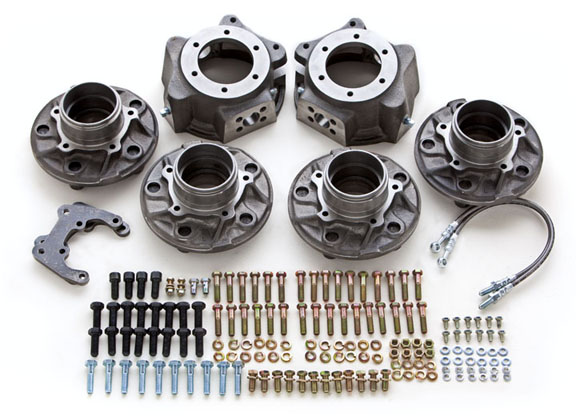
This conversion kit is out of production. I include it here because you may encounter a used or uninstalled conversion kit. This kit was developed by Timm Cooper and put into production for a few years in the 1990's. They once again went into production around 2012 for a year or two. When the kits were available they were offered both directly and through Rovers North.
Here is what the 4 wheel disc brake conversion consisted of:
Below is a swivel housing assembled on a truck ready for the hubs to be mounted.
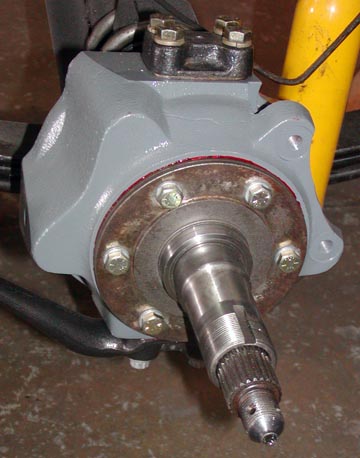 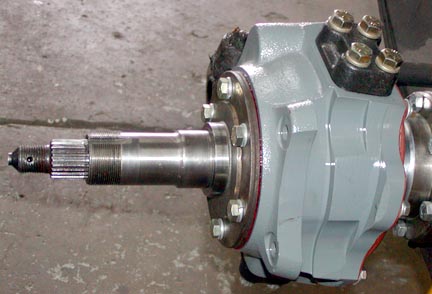
A quick way to tell Timm Cooper's and Heystee Automotive Component's Defender based disc brake kits apart from a quick glance.
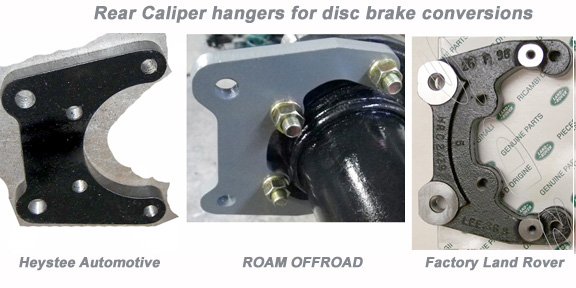
Timm Cooper designed his conversion kit using a single swivel housing casting for both sides of the vehicle. The casting is machined differently depending upon which side it is intended to be used for. So a quick glance at the housing will show two sets of caliper mounting ears. One machined at the back and one not. The Heystee Automotive Components conversion uses two different swivel housing castings each designed for a single side. So there is only a single caliper mounting bracket on each housing vs, two per housing.
Torrel Industries conversion kit:
Sold as a complete kit through Rocky
Mountain Expedition Equipment Ltd. Call 604 913 7910 and ask for Jaremy for current information.
This 11
inch vented brake kit was engineered by Mel Brown and
uses common (North America) AC Delco dual piston calipers,
pads and rubber hoses. This is a 2 piston system
that works with Series master cylinders They suggest
that the Series III dual circuit power brake system be
used. The back plate that mounts to the swivel
housing and the hub are custom parts. The rotor
is a GM rotor that has the centre machined to a larger
diameter. Other than those 3 parts, everything
else is standard off the shelf GM brake parts or Land
Rover hub parts. These components were used on
high performance models of the Chevy Lumina, Monte Carlo, Pontiac
Grand Prix, Oldsmobile Cutlass Supreme and Buick Regal. They
recommend telling your part dealer that you need parts
for a 2001 Chevy Lumina.
A step by step
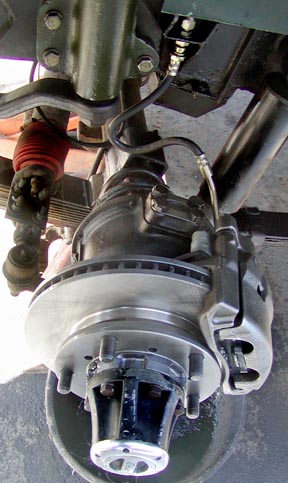
description of a my front disc brake conversion using the Torrel
Industries conversion kit |
 |
Zeus conversion kit:
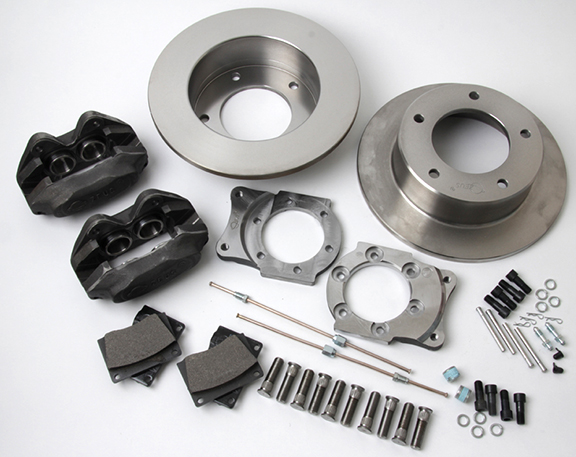
Zeus changed hands in 2012. The new owners revamped the product line and are now back with disc brake conversions for Series Land Rovers. Zeus remains a British company and now offers both front and rear disc brake conversions for Series I, Series II/III and the 101. The disc brake conversions are bolt on and does not require any modifications to your swivel housing other than pressing in new wheel studs. The caliper mount replaces the drum brake back plate. This conversion requires that you use 16 inch wheels to allow clearance for the calipers.
Zeus web site
|
The brake system
I strongly recommend making sure that your brake system is in
top condition when installing a disc brake conversion. Land
Rover recommends replacing all rubber in a Series Land Rover brake
system every 2 years. If you have not done it, this
is the time to flush the brake tubes, replace all the rubber
hoses and the rear cylinder rubber. If you have been contemplating switching
from DOT4 brake fluid to DOT5 silicon brake fluid the time to do
it is when you flush the steel tubes and replace all the rubber.
This is also when you want to inspect the steel brake lines for
rust spots and replace if found. All
the manufactures of Series Land Rover disc brake conversion kits
suggest that you convert to a power brake system. I
have a web page describing common conversions from Series Land Rover single circuit brake system to dual circuit power
brakes.
Return to page top
|